




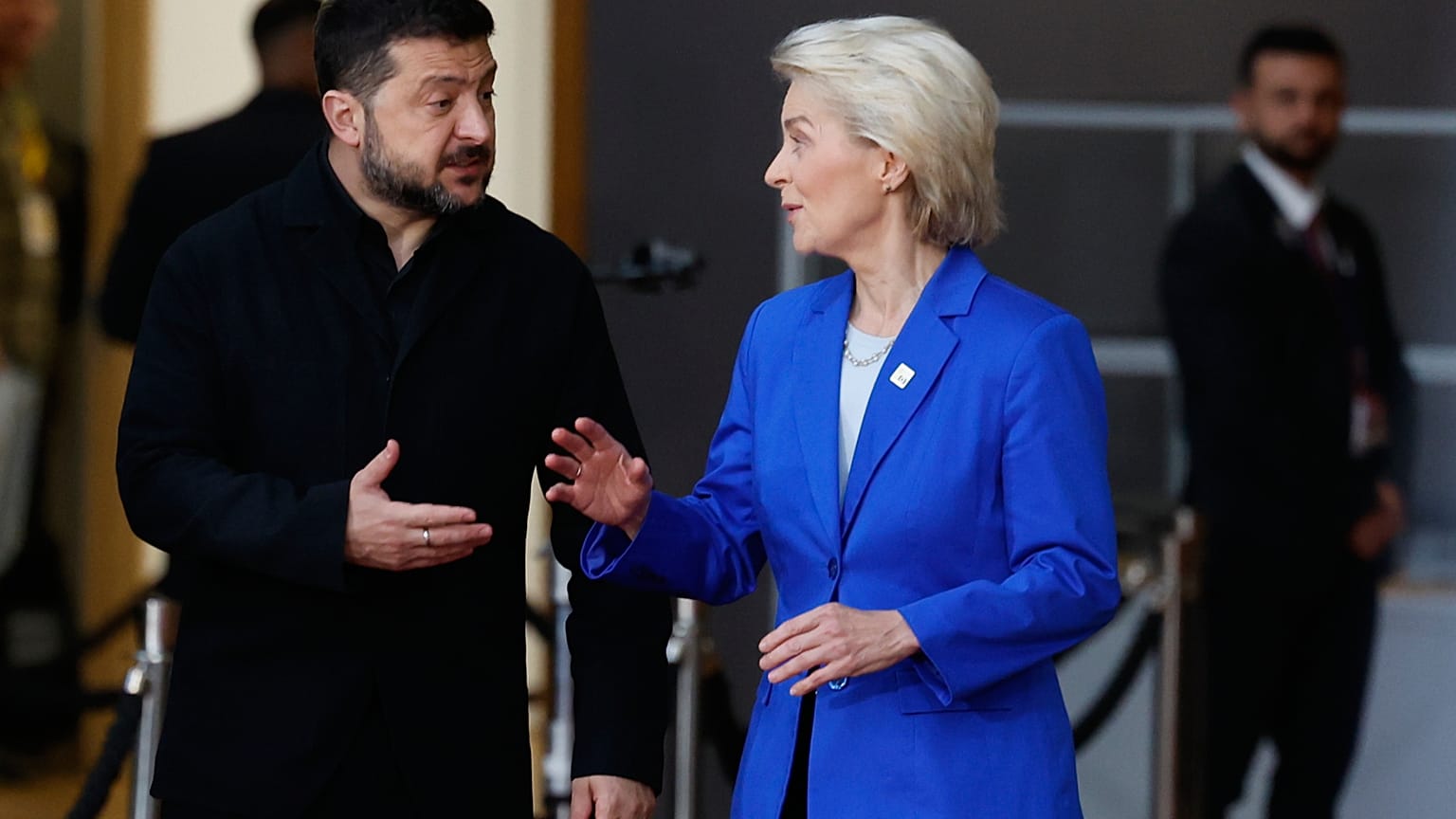












Обостряющееся противостояние между Зеленским и Трампом - в центре внимания второго дня саммита ЕС, в котором принимает участие президент Украины.
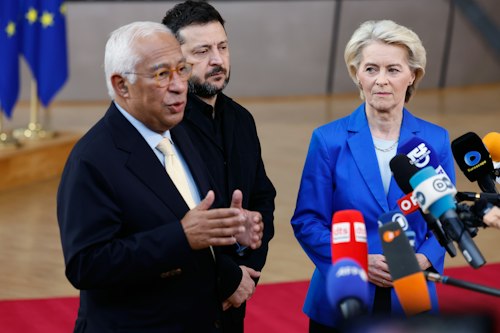
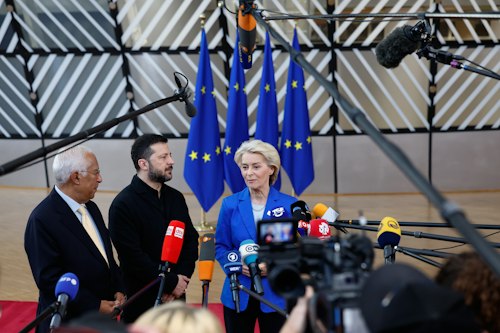
Евросоюз сохранит режим санкций против России до тех пор, пока Москва не прекратит свою агрессивную войну против Украины, — заверили в пятницу Владимира Зеленского председатель еврокомиссии Урсулу фон дер Ляйен и глава евросовета Антониу Кошта.
 РЕКЛАМА
РЕКЛАМА
РЕКЛАМА
"Сейчас мы работаем над 22-м пакетом санкций. И одно абсолютно ясно: мы не снимем никаких санкций, пока Россия не прекратит войну", - заявила председатель ЕК.
"Сейчас не время отказываться от поддержки Украины. Сейчас не время ослаблять санкции против России. Сейчас самое время усилить нашу поддержку и усилить давление" - подчеркнул глава Евросовета.
Их заявления во второй день саммита стали упреком в адрес президента США Дональда Трампа, который ослабил санкции в отношении России, чтобы заключить сделку о поставках дизельного топлива.
Трамп потребовал от Украины прекратить атаки на российские нефтеперерабатывающие заводы, которые он обвиняет в росте цен на топливо. Зеленский жёстко ответил, заявив, что на самом деле за нарушение поставок отвечает война Трампа против Ирана.
Кампания против российской нефтяной отрасли будет продолжена без всяких ограничений, заявил Зеленский, отмахнувшись от опасений, что Вашингтон в ответ может перекрыть каналы разведданных.
От лидеров ЕС, многие из которых рассматривают дальнобойные удары как главный рычаг давления Киева на Москву, ожидается, что они сомкнут ряды вокруг украинского лидера и продемонстрируют общий фронт, пока трансатлантический альянс переживает очередной кризис единства.
После встречи с руководством ЕС Зеленский поблагодарил руководство ес и европейские страны за неизменную поддержку, он сообщил что на встрече обсужали, в частности, потребности украины в сфере энергетики и ПВО. Он также заявил, что не видит сигналов от России о прекращении войны:
**"**Мы пока не видим сигналов со стороны России о том, что она готова положить конец этой войне, поэтому нам нужно готовиться к зиме".
Следите за обновлениями в нашей онлайн‑трансляции.

 ${title}
Ukraine will 'live with dignity' no matter way, Zelenskyy vows
Volodymyr Zelenskyy told reporters that he received "support and only support" from EU leaders amid his bitter row with Donald Trump and pledged his country will continue to live "with dignity" no matter what.
"I'm grateful to them for this. They understand Ukraine's position. It's a clear, pure and entirely justified position," he said. "And I believe that the diesel deal struck between the US and Russia. It was an arrangement we were unaware of. And lifting sanctions, it was also a surprise for everybody."
Zelenskyy predicted the diesel deal will have a limited effect on lowering prices ahead of the midterm elections, where Trump's Republicans trail Democrats.
"We're here not talking about the reasons, but we're talking about the consequences," he said. "If there is no energy ceasefire, give us anti-ballistic missiles so that I can protect my energy facilities. Don't give too many. Give us for the period you'll need. For the duration of the diesel deal. I have not received that."
Asked about mending fences with Trump, Zelenskyy said contacts were ongoing at a lower level between the negotiating teams.
"We will keep living, fighting, and most importantly, living with dignity," he said. "It's very important the quality of life when it is so horrific during the war. It's very important that you preserve your dignity."
France and Germany strike deal on 2035 car targets and 'Made in Europe' rules
Paris and Berlin reached an agreement on Friday on the sidelines of the EU summit to ease the EU’s 2035 ban on new combustion-engine cars in exchange for tougher rules favouring European-made products.
The deal comes as Germany has been pushing for greater flexibility for its automotive industry, while France has championed a strict European preference in public procurement and public funding schemes to counter Chinese competition in the EU market.
“This creates a European preference to ensure that our factories do not become mere assembly plants,” an Élysée source said after the deal was reached.
Under the agreement, countries geographically close to the EU, including Norway, Switzerland and the UK, can be included in the “Made in Europe” rules, provided they allow EU businesses to participate in their own public procurement procedures and do not serve as backdoors for third countries to circumvent EU rules.
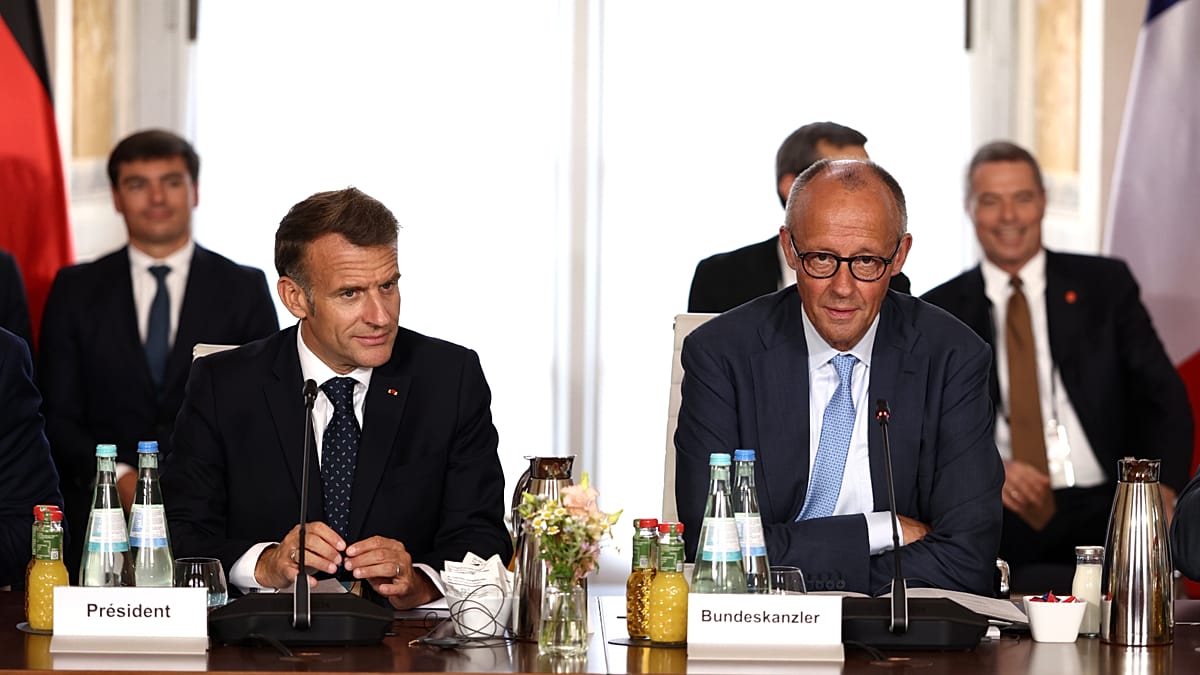
France and Germany deal links 2035 car rules to ‘Made in Europe’ push
Under the agreement, carmakers would be required to cut their CO₂ emissions by 90% by 2035, without having to offset the remaining 10%, as initially proposed b…
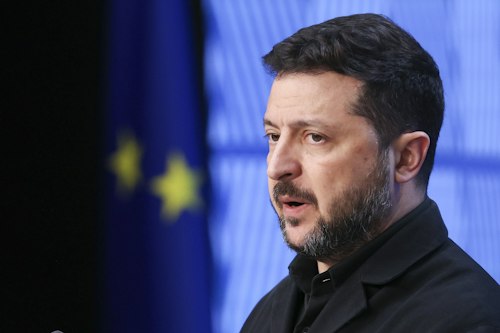
Putin is testing NATO, Zelenskyy says
Volodymyr Zelenskyy used his EU summit press conference to not only condemn Russia's escalation against Ukraine but also against Europe as a whole. The past few months have seen a sharp rise in hybrid warfare across the continent, including drones, arson and sabotage. Some of these incidents have been attributed to Russia, while others are under investigation.
"Putin wants to destroy us. He doesn't respect us, our sovereignty and territorial integrity. He really thinks that we are not a country, not a nation," Zelenskyy said, warning Putin won't be satisfied with just the Donbas region.
"Twenty million (people) will come to Europe, Ukrainians, because he will destroy and push us out. It's understandable. For me, it's absolutely clear. That's why we're asking: stay strong, defend our country. Yes, with pain, with huge losses," he added. "What he wants really is part of our country. Never enough for such a person. Never."
Zelenskyy then accused Putin of "testing" NATO's resolve to collective defence with the spate of hybrid attacks.
"NATO are not loud. These countries, it's understandable, they don't want to escalate. It's understandable when you have one drone, two drones, ten... but you will be very loud when there will be ballistic missiles, cruise missiles and thousands. Can you imagine?" he said.
"Yesterday (there were) thousand drones in Ukraine, thousands, but the American side said that It's difficult to speak with Zelensky. It's less difficult to manage with Putin, of course."
Credit: European Union
Russia's ambitions are 'broader' than just seizing Donbas, Lithuanian president warns
Lithuanian President Gitanas Nausėda told reporters on his way out of the European Council summit on Friday he believes Russian President Vladimir Putin wants more than just Ukraine's Donbas, and this is an excuse to stall ceasefire negotiations with the Ukrainian president.
"Russia is raising the question of taking control of the entire Donbas region and knowing that the Ukrainians will not agree, Russia can then hide behind this argument and say, 'Look, they refuse to agree," he said.
"That means peace negotiations are impossible."
Nausėda also said that "Russia's real ambitions are broader" than solely the territory alone.
The Donbas region comprises two regions in Ukraine's east, Donetsk and Luhansk. Ukrainian President Volodymyr Zelenskyy said in his own statements to reporters in Brussels on Friday that he would reject any proposal to cede the territory to Putin.
"We’re now standing and fighting. What’s the alternative? Annihilation," he said.
'It's easier dealing with Trump than with Putin,' Zelenskyy tells Euronews
Volodymyr Zelenskyy has pushed back against Donald Trump's claim that he is more difficult to deal with than Vladimir Putin, insisting that his priority remains defending Ukraine's interests and securing an end to the war.
Asked by Euronews about Trump's remarks at Friday's EU summit in Brussels, Zelenskyy insisted that for him, dealing with the US president was easier than dealing with Putin, saying their meetings had always produced opportunities for discussion and decisions.
"I defend the interests of Ukraine and the Ukrainian people exclusively. We were attacked, occupied and our people were killed. It is only logical that we have the right to defend ourselves," he said.
Zelenskyy accused Putin of having no genuine interest in peace negotiations, describing Moscow's rhetoric as "a parody of a genuine desire to end the war".
"He does not want the war to end. I am convinced that this is why even the Donbas is too small for him," Zelenskyy said, referirng to the parts of eastern Ukraine which Russia has been trying to occupy since 2014.
The Ukrainian president also warned against easing sanctions on Russia, arguing that recent agreements involving Russian diesel could pave the way for broader concessions, including on gas, banking and other sectors.
He stressed that frozen Russian assets were also at risk, defending his refusal to compromise on issues he considers fundamental to Ukraine's security.
"In my view, we cannot accept these diesel deals, these agreements, because gas deals will follow. I am absolutely certain of this. After gas, sanctions will be lifted on other things as well," he said.
"If I do not defend this, who will do it for us?" he said.
Zelenskyy bets on European track for peace talks
Asked about the peace talks, Ukraine President Volodymyr Zelenskyy expressed hope that Europe could find a "certain format to speak with the Russians" directly so that Kyiv would not have to rely solely on Washington's diplomacy.
"I believe all of this will happen. It doesn't mean we'll exclude somebody from this process," he said. "I've seen some things moving in parallel. We would strongly like to have several of these tracks."
So far, Europe has been represented by the E3 of France, the UK and Germany at the US-led peace process. The European Commission and NATO have also taken part in the process. In June, European Council President António Costa confirmed he had opened a channel of communication with the Kremlin but warned that the conditions weren't yet conducive to peace, given Moscow's relentless attacks.
Use assets now before Russia gets them back, Zelenskyy tells Europeans
Volodymyr Zelenskyy has once again urged European allies to turn the immobilised Russian assets into a support line for Ukraine before Moscow seizes them back.
"We’re grateful for the decision made last year on the €90 billion support loan," Zelenskyy said in the press conference.
"The main priority is that Russia doesn't have the opportunity to influence later on the discussion on these assets, because we know very clearly they want to bring these assets back. It's one of Russia's aims," he added.
"So Ukraine would like to receive these funds in some kind of format."
His comments come as the FT reported that US negotiators floated a plan last week to release a share of the assets as an incentive for Moscow to engage in peace talks. Europeans, who control the assets, shot it down.
Magyar: Hungary stands in 'full solidarity' with Ukraine
Hungarian Prime Minister Péter Magyar expressed his "full solidarity" with Ukraine after concluding his first bilateral meeting with Ukraine's President Volodymyr Zelenskyy in the margins of the European Council.
Writing on social media, Magyar welcomed the political agreement between Hungary and Ukraine on strengthening the rights of the Hungarian minority in Transcarpathia.
"We considered the adoption of the Law on Minority Education by the Parliament of Ukraine based on the agreement as a first step towards restoring mutual trust, and that the Ukrainian side immediately began its implementation" Magyar said, adding that consultations will continue on ministerial level.
"I assured the Ukrainian President of my full solidarity with the inhuman Russian aggression against his country that has been going on for almost 5 years" Magyar added.
According to his statement, Hungary is ready to provide assistance with all possible diplomatic means in establishing an early ceasefire and lasting peace.
Zelenskyy-Magyar meeting finished
The first bilateral meeting between Ukraine's President Volodymyr Zelenskyy and Hungarian Prime Minister Péter Magyar has concluded, Euronews learned.
Details about the discussion are not released yet.
The meeting comes after years of tension between the two countries.
Magyar said on Thursday that the talks would last 10-15 minutes and that the two leaders would take stock of bilateral relations, including the rights of the Hungarian minority in Ukraine.
Zelenskyy about to give press conference
The press room is packed with journalists ahead of a hotly anticipated press conference with Volodymyr Zelenskyy following his talks with EU leaders earlier today. We'll keep you posted.
Several countries push for changes to migration section of summit conclusions
Several EU leaders are pushing to amend the section on migration in the summit conclusions, according to three diplomats.
Denmark is among the countries most actively seeking changes, having tabled what one diplomat described as “outlandish amendments”.
Danish Prime Minister Mette Frederiksen criticised Spain’s plan to legalise the status of 600,000 migrants on her arrival for the summit’s second day, accusing Madrid of doing “almost the exact opposite” of other EU countries and escalating a migration row with fellow Socialist Pedro Sánchez.
Other countries, including Italy, also want to raise the issue during the discussion.
The debate, scheduled over lunch, is expected to be heated. “The disagreement among leaders on this issue is no secret,” another diplomat told Euronews.
20 EU countries informally discuss upcoming initiatives on migration
On the margins of the EU summit, Italy's Giorgia Meloni, Denmark's Mette Frederiksen and the Netherlands' Rob Jetten hosted an informal meeting with the countries "most interested in the issue of innovative solutions to be applied to the management of migration," according to a note from the Italian Prime Minister's office.
Besides the organisers and the European Commission, the meeting was attended by Austria, Belgium, Bulgaria, Cyprus, Croatia, Finland, Germany, Greece, Italy, Latvia, Lithuania, Malta, the Netherlands, Poland, Slovakia, Slovenia and Sweden.
The idea was to take stock of the progress made on the migration issues and to discuss upcoming initiatives, focusing on preventing mass irregular arrivals, the exploitation of migrants and the implementation of the new European regulatory framework.
Meloni, in particular, raised the issue of a targeted review of European legislation to make the new procedures relating to the detention of irregular migrants during border procedures more effective.
Zelenskyy leaves the room
Ukrainian President Volodymyr Zelenskyy has left the room. EU leaders will continue the debate on Ukraine on their own.
Italy and Spain end border checks row
Italy and Spain have committed to ending their bitter row over temporary border checks, which erupted in the aftermath of the Ceuta border crisis in late July. After Rome announced the measures, Madrid retaliated in kind. Brussels was caught in between, unable to restore the passport-free Schengen area.
On Thursday, Giorgia Meloni and Pedro Sánchez decided to close the acrimonious chapter and move on.
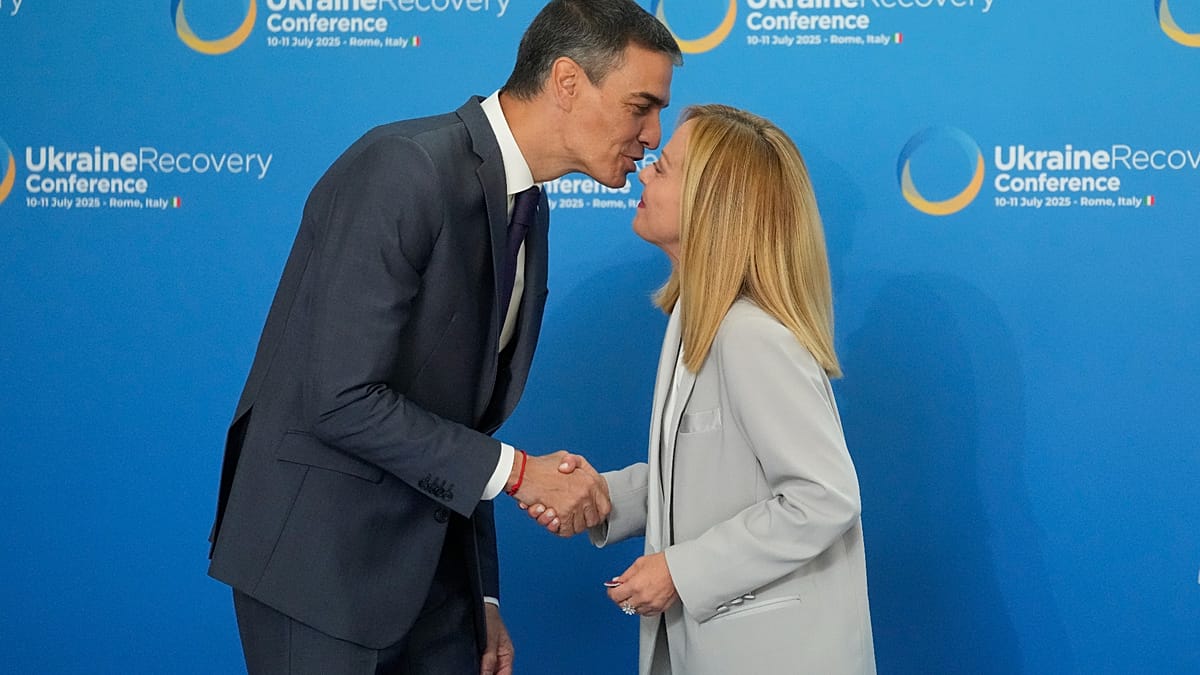
Italy and Spain edge towards ending border checks after leaders meet
Italy's Giorgia Meloni, who met with Spain's Pedro Sánchez, agreed a short extension to align the expiry of Italy’s border controls with Spain’s reciprocal mea…
EU leaders not yet ready to reopen debate on Ukraine financing
The European Union is coming to terms with the fact that its multibillion-euro support for Ukraine won't be enough next year as Russia launches an all-out campaign to devastate the local economy.
Railways, warehouses, data centres, power stations and water facilities have all come under attack in recent months. The blockade in the Black Sea prevents farmers from exporting their grain, and the non-stop drone strikes force businesses to close down in the middle of the day. The goverment has already raised the alarm about a fall in tax revenue.
For next year, Brussels intends to disburse €45 billion under the support loan, in addition to residual funding under the Ukraine Facility and the European Peace Facility. This, however, won't be enough. Kyiv has already flagged a shortfall of $78 billion (about €70 billion) for next year, combining military and financial needs.
The European Commission hasn't yet validated the number but admits the hole will be substantial. The problem is that there aren't easy solutions to plug it: joint debt is difficult amid rising borrowing costs, the Russian assets remain highly divisive and bilateral contributions risk leaving the burden on a few wealthy member states.
EU leaders won't address the issue in depth today, but everyone knows that, sooner or later, a serious debate will need to happen.
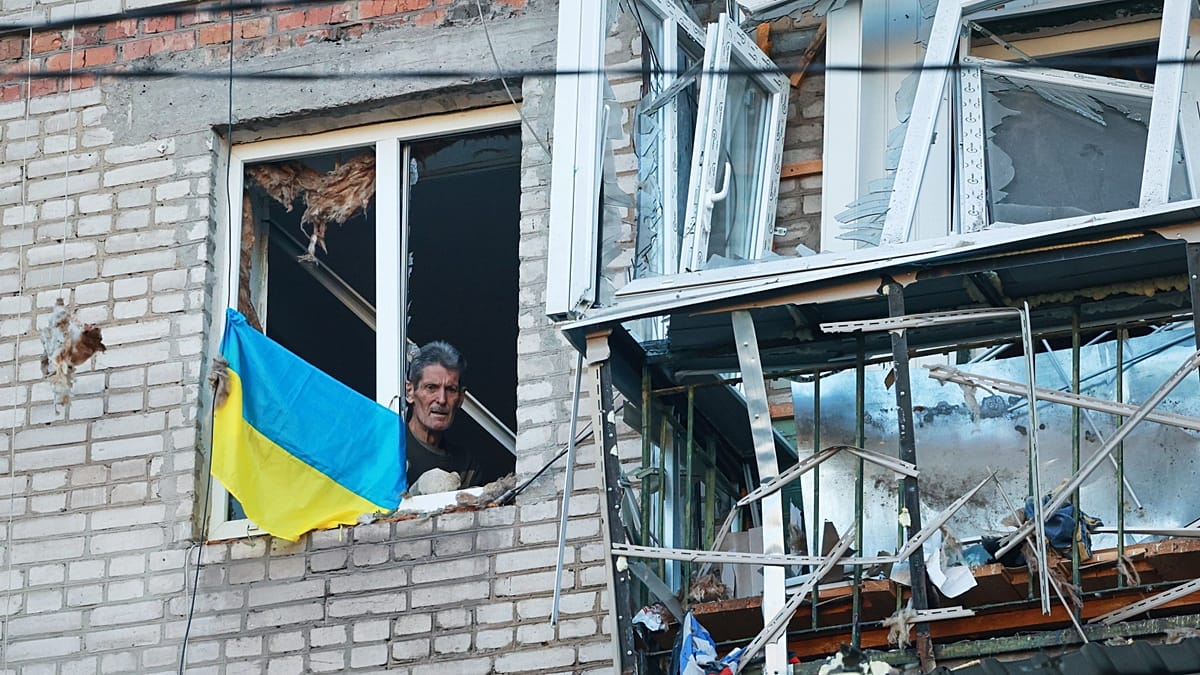
As Russia escalates, EU realises its Ukraine support won’t be enough
Russia’s rapid escalation has thrown into doubt the European Union’s multiple support programmes for Ukraine. Diplomats concede it is only a matter of time bef…
Watch: Zelenskyy's subtle dig at Trump
Ireland 'open' to revisiting Russian frozen assets to pay for Ukraine
Taoiseach Micheal Martin says Dublin is "open" to pushing for using frozen Russian state assets to fund Ukraine. However, the Irish premier said he's conscious of the vast amount of time and energy that went into exploring the issue last year, only for Belgium and other governments to block it.
Funding for Ukraine is falling short for 2027 and 2028, and some countries such as Sweden are renewing calls to use frozen Russian assets located mainly in Belgium. Martin told reporters that Brussels can deliver money to Ukraine soon, but for the medium and long term, "other mechanisms" should be considered.
"We can do stuff now immediately, but in terms of the medium term, over the years 27 and 28, I think we need to focus on that, whether it's to immobilize assets or other mechanisms," he told reporters.
"I'm open," he said, about the use of Russian assets. "But I'm conscious on the last occasion we strongly supported the issue of the seized assets and whether they could be deployed, but that came to nothing in the end," Martin said. "I'm conscious of the amount of energy and effort put into that on the last venture" yet the proposal fell flat.
He added that funding for budgetary and military purposes needs to happen "efficiently and effectively", because "Ukraine is under pressure."
"But so is Russia, and we have to maintain the pressure on Russia," he said.
Suspending asylum applications during crises 'a great step forward,' Austrian Chancellor says
Christian Stocker welcomed the announcement by European Commission President Ursula von der Leyen to develop a specific legal framework for exceptional situations, calling the idea of suspending the right to request asylum in crises like Ceuta "a great step forward."
"I come from the group of like-minded states that have been coming together here for more than a year on this very topic. What was initially a small group has become a large one. The majority of the heads of state and government of the European Union who belong to this group are now included," he said.
Stocker also criticised the Spanish government for its decision to regularise around half a million irregular migrants, arguing it did not send a good signal and that it might have played a role in triggering the crisis this summer.
"We are trying in Europe to fight illegal migration. We are trying to secure our borders. We are trying to win third countries where we will also have return centres that will conduct procedures there," he added.
Magyar and Zelenskyy to meet at noon
The Hungarian Prime Minister Péter Magyar will meet Ukrainian President Volodymyr Zelenskyy at noon, he said in a Facebook post.
It will be their first bilateral meeting, after years of tension between the two countries. Magyar said on Thursday that the talks would last 10-15 minutes and that the two leaders would take stock of bilateral relations, including the rights of the Hungarian minority in Ukraine.
In his post, Magyar also said that the Visegrád Four (V4) group and Italy had achieved a breakthrough on tackling high energy prices during talks in Brussels last night. He gave no further details.
“And today comes the tightening of action against illegal migration,” the Hungarian prime minister added.
Austrian Chancellor calls for transparency on Ukraine's budget gap
The Chancellor of Austria, Christian Stocker, called on Kyiv to clarify the reasons behind its budgetary shortfall, currently estimated at around $27 billion.
"Where does this gap come from? I'm also surprised. A lot of it is not implausible. Of course, these intensified, massive attacks by Russia have caused more damage; that's clear. But the fact that this has a direct effect on a budget hole, if you will, is something that will be talked about," he said.
Stocker highlighted that last year the EU made €90bn available to finance Ukraine's war efforts, a large sum, but now the Ukrainian government is asking for more financial support.
"It will be necessary to explain this transparently and, at the same time, to explain to what extent the conditions to which the financing is linked, such as the rule of law, reforms, the issue of combating money laundering, the fight against corruption, to what extent these conditions have also been met and implemented," he continued.
Ireland pushes for EU budget deal before Christmas as Ukraine funding needs grow
The EU should reach an agreement on its next long-term budget before the end of the year, Irish Taoiseach Micheál Martin said, arguing that geopolitical uncertainty makes a deal increasingly urgent.
"It's clear that negotiations are now in earnest. And I think the negotiating box that we presented achieved an objective of really acting as a catalyst for the next phase of negotiations on the MFF, which I believe we need to get done before the end of the year," Martin said.
The negotiations are now entering a serious phase, the Irish leader said, after their proposal was met with resistance from the net contributors who argued the proposed budget was out of touch with reality.
An agreement would give the EU greater clarity over what it can finance, including support for Ukraine, whose needs are expected to remain substantial in 2027 and 2028.
EU leaders clap as Zelenskyy enters the room
EU leaders clapped as Volodymyr Zelenskyy entered the room of the EU summit, a sign of support amid his bitter row with Donald Trump. The meeting will begin with Zelenskyy's traditional address to leaders.
Ireland open to using frozen Russian assets to support Ukraine
Irish Taoiseach Micheál Martin said he was open to using frozen Russian assets or other mechanisms to help finance Ukraine, but stressed the need for an effective solution after previous efforts to seize the funds failed to secure agreement.
When it came to funding Ukraine, Martin said Europe needs to "prepare immediately and focus on the medium-term 2027 and 2028", whether it's to" immobilise assets or other mechanisms."
"I'm open. I am conscious. On the last occasion, we strongly supported the issue of the the seized assets and whether they could be deployed," Martin said.
The EU must "urgently work out how" to finance Ukraine’s needs in 2027 and 2028, Martin said, as Russia is intensifying attacks on civilian infrastructure.
“We have to maintain the pressure on Russia,” he said, accusing Moscow of trying to force Ukraine into surrender through attacks on civilians.
EU-US cooperation 'very difficult' now, Kallas says
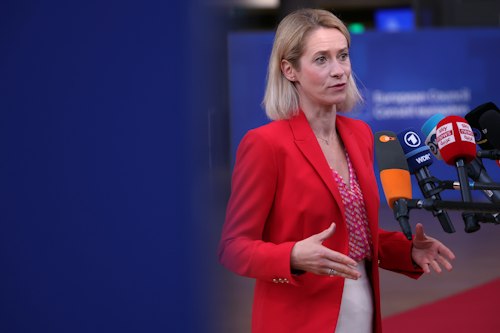
EU-US cooperation on Ukraine is "very difficult" now, High Representative Kaja Kallas said on Friday morning, expressing once again her regret over Donald Trump's decision to strike a diesel deal with Vladimir Putin.
"We are working on the new sanctions package to put pressure on Russia. And, we, of course, hope that we do this with all our partners around the world," Kallas said before the EU summit.
"We are trying to convince also our American partners that, if we want to end this war, then we have to squeeze the aggressor," she added. "Because it's not only to end this war, but to make sure that there are no more wars started by Russia."
Rising tensions between Zelenskyy and Trump have led to restrictions on Ukraine's use of the Starlink satellite technology, owned by Elon Musk.
"Starlink is really necessary for Ukraine. And unfortunately, in the short term, Europe can't replace this capability," Kallas said. "That's why we have also, today, the discussion about defence readiness."
Kallas predicted the upcoming winter in Ukraine is going to be "really grave" and "harsh" as Russia escalates its non-stop attacks.
"We don't see any signs from Russia that they want to stop this war, or they are into any kind of truce," she said. "And that's why we really need to help Ukrainians to survive (and) defend their country."
Credit: Associated Press
Cyrpus President slams decision to cancel EU-Gulf summit
Cyprus President Nikos Christodoulides criticised the decision to delay the EU-Gulf summit, originally planned to take place on 24 October 2026 in Riyadh, following a series of air strikes from the Yemeni armed group Houthis.
"As we rightly do in the case of Ukraine and visit the country in difficult times, when Russian missiles are hitting Ukraine, we must do the same in relation to the countries in the region," he said.
Christodoulides added that Cyprus was the only EU country to send a minister during an energy meeting a few days ago.
"In these difficult times for the countries of the region, we must be there. I do not consider the postponement of the summit to be a positive development," Christodoulides added.
Watch: Von der Leyen rebuffs sanctions relief for Russia
Spain’s plan to legalise 600,000 migrants faces EU summit scrutiny
Spain’s plan to regularise around 600,000 undocumented migrants will be debated at the EU summit on Friday, amid concerns among several member states that the move could have knock-on effects across the bloc.
The migration debate, scheduled for Friday lunchtime, will include a section “on the unintended consequences of national decisions on migration,” according to a diplomat.
Prime Minister Pedro Sánchez’s plan has sparked controversy across the EU and has been criticised by countries such as Italy and Denmark over concerns that it could act as a “pull factor” attracting more irregular migrants. In August, EU Commissioner for Migration Magnus Brunner described it as “not a good signal for the rest of Europe”.
Madrid argues that regularising undocumented migrants will help integrate them into the national economy and even reduce secondary movements to other EU countries.
Italian sources told Euronews that the issue could be included in the summit’s conclusions, although the latest draft does not mention it.
Denmark seeks progress this year on EU migration centres outside Europe
Denmark is hoping to announce new proposals for migration centers outside the EU before the end of the year, Prime Minister Mette Frederik said.
"Things are moving in the right direction, and I hope we can bring something new to the table this year," she said.
"We also need to put a stop to instances where actors outside of Europe use human beings as part of hybrid warfare — specifically, by pushing migrants and foreign nationals across the border," the Danish leader added.
"We have seen this happen in several countries, and there is a growing consensus that this must be stopped immediately," Frederiksen said.
Copenhagen has asked the European Commission to examine cases in which people entering a country illegally are subsequently granted legal status, arguing that such practices undermine the EU’s broader migration policy.
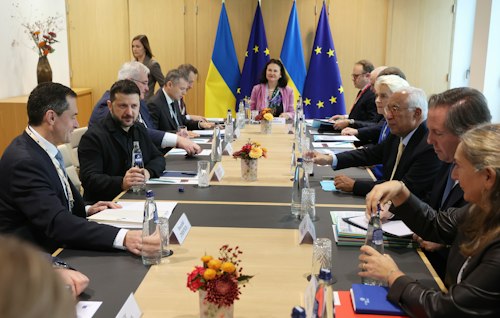
Zelenskyy, von der Leyen and Costa hold trilateral meeting ahead of EU summit
Ukrainian President Volodymyr Zelenskyy is currently holding a meeting with European Commission President Ursula von der Leyen and European Council President António Costa ahead of the EU summit.
Topics on the meeting include military and financial support, emergency aid ahead of the winter and Ukraine's accession process.
Credit: Associated Press.
Denmark: Frozen Russian assets are Europe’s best way to fund Ukraine
Danish Prime Minister Mette Frederiksen has revived calls fo the EU to seize Russia's frozen assets to help finance Ukraine’s defence, arguing the move would make Moscow pay for the destruction it is causing.
“I still think it is one of the best solutions we have right in front of us,” Frederiksen said, criticising EU countries blocking the proposal.
Using the assets would serve a “double purpose”, she added, funding Ukraine’s defence while making Russia bear the costs of its war.
Ukraine is already struggling to pay for the weapons and military equipment it needs, Frederiksen warned, as Russian attacks increasingly target the country’s energy infrastructure ahead of winter.
"Denmark will continue to provide whatever assistance we can — specifically the support they so desperately need right now. It concerns air defence for Ukraine, which was one of the topics we discussed yesterday," Frederiksen said.
She added that the EU "urgently" needs to secure funding for Ukraine in 2026 and ensure sufficient resources are available in 2027, the leader said.
“If we help Ukraine, we also help ourselves,” the Danish leader said, describing the country as Europe’s first line of defence.
Italy extends border checks with Spain, solution expected next week
Italy has extended the temporary border controls on people arriving from Spain by seven days. The Interior Ministers from the two countries are expected to work out substitute measures next week.
The random controls – at airports, as the two countries have no land borders – were introduced following the Ceuta crisis at the end of July and had been extended every two weeks, most recently until Thursday night.
Spain responded with reciprocal measures, which are due to expire on 22 October. As a result, the two national measures are now aligned and will expire on the same day.
Italian Prime Minister Giorgia Meloni, who leads a hard-right government, and her Spanish counterpart Pedro Sánchez, a centre-left leader, have repeatedly clashed over migration policy, including at the European Council in June.
Migration will again feature on EU leaders’ agenda today, with a strategic discussion over lunch. Spain is heading towards elections on 29 November.
EU-Turkey summit planned in October, Cyprus President says
The EU and Turkey will meet "at the highest level" in October, Cyprus President Nikos Christodoulides said, adding that he hopes it will lead to new talks on a framework for the divided island country.
Turkey has occupied roughly 40% of the island since 1974. The summit is being organised at the request of the United Nations Secretary-GeneralAntónio Guterres, Christodoulides said.
"This development, combined with the arrival of the UN Secretary-General's personal envoy to Cyprus at the end of October, can create the conditions for us to have positive developments. Our clear political will is a given, and I repeat that the European Union can play a leading role," he added.
White House ordered Starlink to cut Ukraine's access, Reuters reports
An order to restrict Starlink satellite communications used by the Ukrainian military came from within the White House, Reuters reported, citing US and Western officials.
The restrictions, reportedly introduced without warning on Wednesday, imposed a speed limit of 160 kilometres per hour on terminals operating in motion, disrupting Ukrainian military operations, including strike missions and the use of interceptor drones to defend against Russian aerial attacks.
According to Reuters, Pentagon officials were instructed to impose the limits on Starshield, the military-grade version of Starlink, although it remains unclear who issued the directive.
SpaceX chief executive Elon Musk said the authority to impose such restrictions lies with the US military and ultimately the president.
'Increase pressure on Russia,' Costa says
“This is no time to relieve Russia’s sanctions. Now is the time to increase our support and increase our pressure,” European Council President António Costa said, adding that Moscow must be pushed towards a genuine ceasefire and negotiations to end the war.
Costa also looked ahead to Ukraine’s European future, with a pledge that EU support must extend beyond the battlefield to helping the country become a member of the bloc.
“This is time for peace. It is not time to continue the war,” Costa said.
"This week we opened more two clusters in our negotiation process (with Ukraine). We need to continue in this process, and I would like to commend you," Costa said, addressing Ukrainian President Volodymyr Zelensky.
Czechia’s PM praises Šefčovič as ‘best Commissioner’ following deal with China
The Prime Minister of Czechia, Andrej Babiš, praised the European Commissioner for Trade, Maroš Šefčovič, as “by far the best Commissioner – an incredible man who has secured some excellent deals for European industry.”
Šefčovič has been leading the EU negotiations with China, in an attempt to rebalance a massive trade deficit that many European leaders consider unsustainable. Last week, he announced an initial deal to cap the imports of hybrid cars.
During yesterday’s discussion, many heads of government stated that they were planning a state visit to China, Babiš said, which remains a partner of strategic importance, most notably for raw materials.
“China not only subsidises its products, but also constantly devalues its currency by 20 per cent, thereby gaining a further advantage. That is why, as a politician, I have always said that we will never allow ourselves to be part of the eurozone, because the Czech koruna gives us precisely the flexibility that, should anything happen in Europe or the wider world, we still have the means to deal with it,” he said.
'EU won't lift sanctions unless Russia stops war,' von der Leyen says
Ursula von der Leyen left no doubt on Friday that the European Union will refuse to lift sanctions on Russia until Moscow ceases its war of aggression against Ukraine, implicitly rebuking Donald Trump for striking a diesel deal with Vladimir Putin.
"We have to increase the pressure on Russia. We are working now on the 22nd sanctions package. And one thing is absolutely clear. We will not lift any sanctions unless Russia stops the war," the president of the European Commission said on Friday morning, speaking next to Volodymyr Zelenskyy.
Von der Leyen backed the energy ceasefire proposed by Donald Trump, which Russia has rebuffed, and said Brussels was working on a new package to support Ukraine ahead of a winter expected to be the harshest yet of the war.
"Russia is trying everything to destroy the energy and water infrastructure. But we stand by your side. We will support you as we did in the other winters," she told Zelenskyy. "We supported President Trump's energy ceasefire, but we've seen that Russia did not respect it. Not a single minute. Instead, Russia escalated.
Von der Leyen praised the Ukranian parliament for "working so hard to deliver the reforms" necessary to advance Kyiv's accession process. The two remaining clusters of negotiations should be opened by the end of the year, she said.
Credit: Associated Press
Zelenskyy says energy and air defence top Ukraine's priorities at EU summit
Volodymyr Zelenskyy said securing energy supplies, air defence and funding for the coming winter would be his top priorities at Friday's EU summit in Brussels, warning that Russia was showing no willingness to end the war.
Speaking alongside António Costa and Ursula von der Leyen upon his arrival, Zelenskyy stressed the urgency of preparing for the months ahead, with discussions also covering Ukraine's needs in 2027.
"We don't see now signals, from Russian side that they are ready for this to end this war," he said.
"That's why we have to prepare for the winter. Winter package. It's not only energy, it's also air defence and fundings."
Zelenskyy also thanked European leaders for their continued support, pointedly describing them as "real leaders" who had stood by Ukraine since the beginning of the war.
"I'm so thankful that we have such huge support from EU Council, Commission and leaders, real leaders," he said.
Turning to Ukraine's EU accession, Zelenskyy welcomed progress in the negotiations and praised the Ukrainian parliament for passing reforms despite sustained Russian attacks.
"We'll do everything to open two last clusters to the end of the year, and I'm sure that we will do it," he said.
Czechs and Italians in joint call for action on energy prices
Czech PM Andrej Babis hailed Italy's campaign to bring down Europe’s energy prices, warning that EU leaders still fail to understand the gravity of the crisis.
"The 'Group of Four' is functioning very well, and we have gained a crucial ally — particularly regarding energy issues — namely, Italy," Babis said, referring to Italy's backing for the Visegrad Four of the Czechs, Slovaks, Hungarians and Poles.
The intervention adds to mounting pressure on Brussels to address the cost of energy as governments warn that expensive power and fuel are weakening European industry and putting additional pressure on households.
"I have raised this repeatedly, yet it does not seem that the European Council fully grasps the gravity of the situation," Babis added.
Time to use Russia's frozen assets, Latvian PM says
Latvian Prime Minister Andris Kulbergs urged European allies to tap into the Russian Central Bank's frozen assets, worth €210 billion in the EU alone, to provide additional support for Ukraine.
"It's simple: there's frozen assets," he said.
"Russia is breaching every single rule. And that is what it's doing for all (the) war and escalating. The frozen assets are there. That's what should be used to support Ukraine. Simple."
A plan to use the Russian assets was tried last year but fell apart after fractious negotiations among EU leaders. Belgium, the country that holds most of the assets, remains strongly opposed, saying the other member states are unwilling to provide it with uncapped guarantees. France and Italy, two key votes, are also reluctant.
By contrast, Germany, Spain, the Netherlands, the Nordics and the Baltics back the use of the Russian assets.
Latvian PM: 'If we want to eat croissant, we have to support Ukraine'
Latvian Prime Minister Andris Kulbergs upped the ante on Friday morning, telling Europeans that if they "want comfort, eat croissants and drink coffee in the morning and don't think about threats, then we have to support Ukraine".
"That's the duty, and that's on our hands," he told reporters.
Kulbergs regretted that the energy disruption caused by the US war on Iran had given Russia a "breeze of (fresh) air" with higher oil prices.
"That is not helping," he said. "Ukraine needs financial support and military support in order to go through this harsh winter, which is going to be ahead of us, and that is our security. That is where we need to support them."
Asked about President Zelenskyy, the Latvian premier said he was a "true leader" who pulled his country "out of misery" at the start of the war, when Russian troops approached Kyiv but were pushed back. "We're united and fully supporting Ukraine, and we're going to do that until Ukraine wins," Kulbergs went on. "Zelenskyy has our back. And he has his back covered from our side."
Czechia's PM warns EU carbon market risks driving industry out of Europe
Czechia's PM Andrej Babis is again stepping up its attack on the EU’s carbon market, warning that the bloc’s emissions trading system is undermining EU industry and that its planned extension to heating and road fuels could further squeeze households.
"I reiterated that the first phase of the Emissions Trading System (ETS) is destroying European industry, and that ETS II will ruin the lives of European citizens," Andrej Babis said.
The Czech leader argued that the ETS is accelerating the loss of industrial capacity, including refineries, while ETS2 risks pushing up the cost of living, including housing.
Czechia, alongside Hungary, Slovakia, Poland, Italy and Greece, proposed to delay the ETS2 until 2030 — a demand that was met with resistance by the Nordics and ultimately didn't feature in the conclusions. However, the six countries managed to push for an impact assessment, which the Commission will be tasked to conduct.
The battle over the ETS underlines the growing political pressure on Brussels to address high energy costs as EU leaders struggle to reconcile climate targets with industrial competitiveness.
EU-China trade: Brussels must act on ‘unacceptable’ imbalance, Jetten says
The EU must tackle what the Dutch leader called an “unacceptable” imbalance in its economic relationship with China, combining targeted measures with efforts to strengthen European industry.
"Everyone understands that the imbalance between the EU and China is not just uncomfortable, but unacceptable," Dutch PM Rob Jetten said.
"We need to take action—on one hand, by implementing measures when necessary, and on the other, by boosting the competitiveness of European companies so they can truly compete with the Chinese in terms of fair pricing and product quality," he added.
He urged the European Commission to come forward with proposals to address the imbalance, putting pressure on Brussels to turn concerns about Chinese competition into concrete action.
Netherlands presses Italy to apply EU asylum rules
The Netherlands is pressing Italy to fully implement EU asylum rules, with Dutch Prime Minister Rob Jetten saying Rome has a responsibility to ensure the bloc’s migration system works.
"She (Italian Prime Minister Giorgia Meloni) is very well aware of the Netherlands' position, as our Minister for Asylum and Migration works very closely with her," Jetten said.
Jetten backed European Commission President Ursula von der Leyen’s call for proper implementation of the EU Migration Pact, including the Dublin rules that determine which member state is responsible for processing an asylum claim.
"It is clear that Italy has a task to fulfill here," the Dutch PM added.
Several countries have failed to implement the rules for years, he said, warning that catching up is essential to making the system work.
Dutch PM says the EU needs to reduce reliance on US tech
Europe must build its own capacity to provide Ukraine with critical connectivity services, the Dutch PM Rob Jetten said, after Starlink access was restored.
Speaking about discussions with the US and a conversation with French President Emmanuel Macron, the leader said Europeans should be able to provide more of these services themselves in the near future.
The Netherlands remains among the top five supporters of Ukraine, focusing on areas where it has particular strengths.
'A good deal is more important than just getting a stamp of approval,' Dutch PM says
Dutch Prime Minister Rob Jetten said the current budget proposal wasn't good enough and that "a good deal" on the EU's multi-annual budget is "more important than just getting a stamp of approval."
"It needs to be much more focused on key priorities—such as our security, our competitiveness and gaining better control over immigration. Furthermore, the burden-sharing is not fair," Jetten added.
Ukraine's attacks on Russian refineries a 'disgrace', Trump says
US President Donald Trump has doubled down on his criticism of Ukrainian President Volodymyr Zelenskyy and his strikes on Russia's oil refineries, calling them a "disgrace".
In an interview with Newsmax, a right-wing TV channel, Trump said Zelenskyy "is not a good guy for us to deal with" because "he doesn't want to settle" the war that Russia launched. "He says he wants to settle, but he doesn't. No, I'm not a big fan of Zelenskyy," Trump said.
Asked about Zelenskyy's intention to resume strikes against Russia's oil refineries, which have inflicted economic pain on Moscow, Trump reaffirmed his opposition.
"Now, if you tell me that Zelenskyy is again shooting at refineries, all he's doing is making the world oil price higher," he said. "Well, I think that's a disgrace. There's plenty of other targets."
"But when you shoot at diesel refineries where you make, you know, diesel oil and we need that, and the world needs that, then he's not doing a good service for the world."
Trump said Zelenskyy is "more difficult to deal with" than Russian President Vladimir Putin, with whom Trump recently struck a controversial deal to purchase Russian diesel that had until now been under sanctions. The deal sent US-Ukraine relations to a new low. Zelenskyy said he feels betrayed by Trump's actions.
Trump repeated his call for new elections in Ukraine, which are banned under martial law. "I think you need an election because there's nobody that's telling me that the people of Ukraine are satisfied having missiles hitting their apartment building," Trump said.
Leaders begin to arrive
EU leaders are slowly making their way into the second day of the summit. Dutch Prime Minister Rob Jetten is among the first ones to show up.
Stay tuned for updates.
Credit: European Union
Ukraine working on European alternatives to Starlink, top Zelenskyy aide says
As EU leaders begin the second day of their summit in Brussels, with Ukraine's defence needs high on the agenda, a senior Ukrainian official has told Euronews that work is already under way on European alternatives to US-made air defence systems and Starlink satellite communications.
Speaking exclusively to Euronews' Europe Today programme, Ihor Zhovkva, deputy head of President Volodymyr Zelenskyy's office, said the European FREYJA anti-ballistic missile programme had progressed to direct engagement between defence companies.
"We need a European equivalent of an air defence system," he said, adding that Ukraine intended to take a leading role in its development.
Kyiv is also pursuing a European alternative to Starlink, although Zhovkva declined to disclose further details.
Asked whether developing these systems would take too long, Zhovkva said progress would come considerably sooner than sceptics anticipated.
"We have a clear timetable and deadlines," he said. "It will be much faster than ten or fifteen years, and even faster than five."
Zhovkva also insisted that Europe must be involved in any negotiations to end the war, arguing that Ukraine's future security was inseparable from that of the wider continent.
Ukraine takes centre stage on Friday
The second day of the EU summit will have one key purpose: to show the world that Europe continues to be fully behind Ukraine's fight against Russia's full-scale invasion.
Of course, this isn't the first time that this has happened. In fact, it's a message that every EU summit has sent since February 2022. What changes now is the context: Ukrainian President Volodymyr Zelenskyy says he feels betrayed by the diesel supply deal that US President Donald Trump struck last Friday with his Russian counterpart, Vladimir Putin, in open defiance of Western sanctions.
Since then, relations between Zelenskyy and Trump have rapidly deteriorated. Trump has called for new elections in Ukraine, which are forbidden in wartime, while Zelenskyy insists the strikes on Russia's oil refineries, which Trump has asked him to stop, will resume.
What happened yesterday?
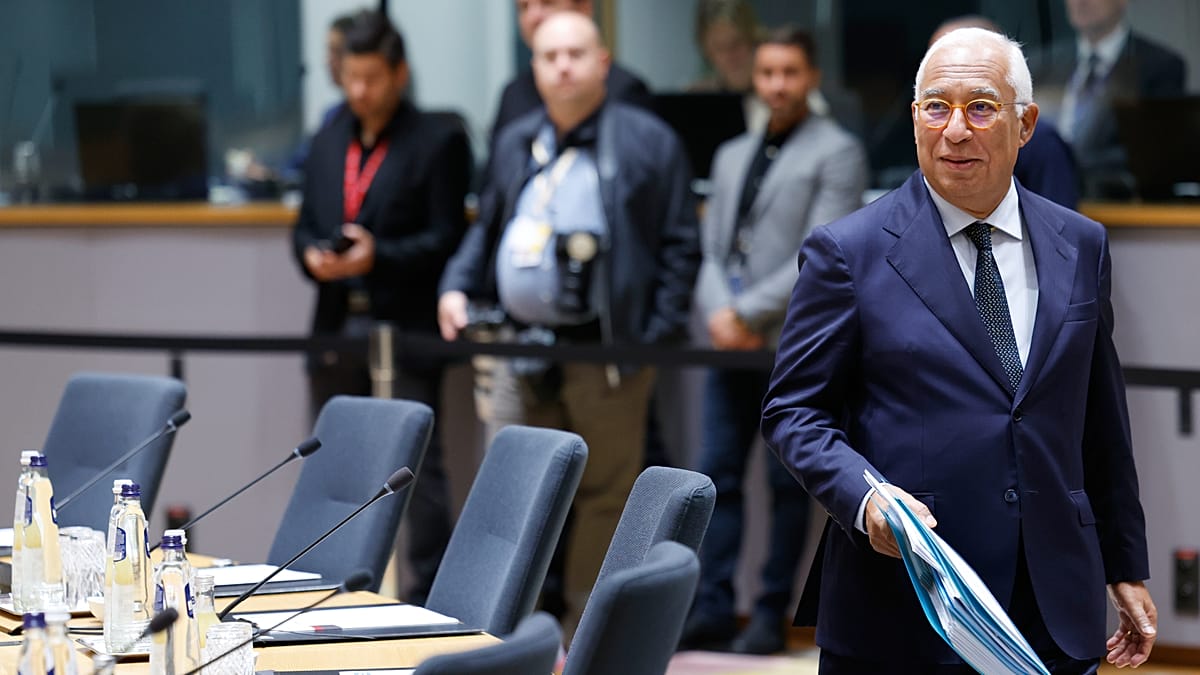
The first day of the EU summit was dominated by the fight over the next long-term budget. At the end of an inconclusive day of talks, António Costa, the president of the European Council, took charge of the negotiations. He has committed to present a new compromise with revised figures ahead of a special summit next month.
Inconclusive sparring at EU summit puts budget timeline into question
EU leaders stuck to their red lines on the next long-term budget at Thursday’s summit, with several now rejecting the presumed December deadline. Council Presi…